Sunday, June 11, 2017

A Remembrance

Theresa Olsen
November 14, 1925 - June 11, 1998
Nineteen years.
You would think after all this time it would be easier.
You would think after all these years I would miss her less.
But it doesn't.
And I don't.

When you're young you can't wait to be independent . . . 
To show the world you don't need anyone . . . 
That you can make it on your own.
But you're not.
And you do.
And you can't.

My generation didn't have mobile phones
to take snapshots of every moment of life. 
But snapshots fade or get deleted
I have MURALS . . . 
CANVASES . . . 
WORKS OF ART, 
In my mind 
And in my heart,
That are there forever - 
Unfading 
Permanent.

I wish I could show them to you!
I wish you could see
All the joy, 
Some of the pain
That tells me to this day 
That I was loved -
Totally . . . 
Unreservedly . . . 
Unconditionally.

Nineteen years.
You would think after all this time it would be easier.
You would think after all these years I would miss her less.
But it doesn't.
And I don't.
And although the male ego is loath to admit it,
An adult is a nothing but a graying balding boy - 
A boy who still 
Misses
Loves
Needs
His Mom.

For those of you who are still fortunate enough
to have your Mom no further than a phone call away,
Don't put it off!
Call her RIGHT NOW!
Tell her that you love her!
Because someday you won't be able to.
Someday all you will have . . . 
(Hopefully you will have)
Murals
Canvases
Works of art
of all the joy,
some of the pain
That warm the heart
But ultimately never satisfy.
Deacon Bruce Olsen
June 11, 2017

Sunday, May 28, 2017

The Seventh Sunday of Easter (Cycle A)

LAST WORDS - ETERNAL PRAYER
Acts 1: 12-14; 1 Peter 4:13-16; John 17: 1-11a 

Last words. 

Last words are important to us. They fascinate us; they’re things we can take to heart, things we consider worth remembering. We always want to get the last word in, don’t we? Getting the last word in can be petty, but oh so satisfying. To us it means that we won, we were right, what we said will be remembered and will be acted upon.

Last words are important words . . . 

In a court of law deathbed statements, even though they are unsworn and the person no longer present to validate them, are admissible as evidence. And in the arena of our lives what we last said to someone before they leave us, and in turn what they may have said to us, are very often the occasion of much joy and encouragement - and sometimes, unfortunately, of much regret and remorse.

We normally take very seriously the last words that our loved ones have uttered to us; we turn those words over in our minds; we consider them carefully; we store them up in our hearts and ponder them - much as Mary stored up the words of the angel and of the shepherds and of the magi in her heart after her encounters with them. 

We attach significance to a person’s last words, especially if that person has lived a notable life. Last words spoken as death approaches often afford a final insight into the essence of a person’s life: what was important to him or her. Sometimes those last words can inspire us to emulate whatever was great or heroic in that person. 

Last words are important words.

In today’s Gospel, the start of the seventeen chapter of John, we hear some of the last words Jesus would speak before his death on Golgatha. They express the essence of Jesus’ life. His life, as we know it from the gospels, was lived in union with God the Father. His last words reflect that same union, for they are a high priestly prayer, a kind of intimate family conversation. So today’s Gospel is a very difficult one to preach on. Why? Because we’re not hearing Jesus proclaim his profound, life-changing teachings. We’re not witnessing his compassionate heart as he brings healing to sick people and food to the hungry. We’re not experiencing his power revealed in raising the dead. His words aren’t even addressed to us but to his Father. It is as if we’re eavesdropping on Jesus. Here, rather, we are allowed to glimpse into Jesus' very soul. We hear Jesus in prayer. We never get any closer to someone than when we know about their prayer life. So it is not overstating anything to say that when we come to this chapter, we are entering holy ground and we should come in a spirit of reverence and humility..

And so, today’s Gospel is not so much one to be proclaimed, broken open, dissected and analyzed as it is to be listened to reverently, to be meditated on and internalized. So rather than commenting on what Jesus says, maybe it would be more beneficial for us to observe what he does and how he does it. He prays. So what are the lessons we can take from today’s gospel? I’d like to suggest three:
  • You Can Pray Aytime:  In the gospels, Jesus prays -- in the morning, in the evening, in the middle of the night. On a mountain, on the plain, when it’s dark and when it’s light. Inside, outside, alone or with friends. In thanksgiving, in distress, and toward all kinds of ends. He prays frequently and fervently. He prays even now, knowing full well what the next day will bring. He forgoes the opportunity for a last minute cram session of his most important teachings with his Apostles and instead, he prays. The point being: prayer isn’t only for church, or for mealtime, or for before bed. You can pray anytime, anywhere, for any reason … and God is always eager to listen. Driving your car to work or the kids home from school. While brushing your teeth in the morning or your hair at night. While doing errands or playing golf. Before a meeting for work or with friends. You can pray anytime. Sounds simple enough, of course, and it is. But that’s part of what many of us are missing in our prayer lives - the sense that prayer wasn’t intended to be extraordinary, saved for certain places or times or reserved only for really important moments. Prayer was meant to be ordinary, part of the fabric of our daily lives. 
  • Prayer Is About What’s On Your Mind and In Your Heart:  Again, so simple. And, again, so easy to forget. When you read Jesus’ prayer in John, it’s easy to get a bit hung up on all the highly relational language of “mine” and “yours” and “they are in me as I am in you” and all the rest. But all of that language simply signifies the tremendous intimacy Jesus shares with the Father and that he is inviting his disciples (and us) into. Beyond that, this prayer is simply Jesus sharing what is most deeply in his heart at the moment -- that he is coming to the end of his earthly mission, that God would see him through to the end, and that God would take care of his friends now that he has to leave them behind. “What should I pray about?” some of you may at times wonder. The answer is easy: whatever you’re worried about, or thankful for, or need support with. In short, whatever is on your mind or in your heart. 
  • We Never Pray Alone:  If you read a little bit beyond the point where today’s Gospel ends - to verse 20 - we hear Jesus say, “And I ask not only on behalf of these” -- that is, his disciples -- “but also on behalf of all those who believe on their account” – that’s all Christians since then . . . including us! When we pray -- whenever we pray -- we do not pray alone but know that Jesus is praying with us and for us. At the Last Supper Jesus prayed for us.  He interceded to his Father on our behalf.  He still does. 
Earlier in the gospels, we know that when the Apostles approached Jesus and asked him to teach them to pray, he responded, “When you pray, say: Our Father, who art in heaven . . .” In a way, Jesus is saying, “When you pray, do as I say.” In today’s passage, it is as if Jesus is saying, “When you pray, do as I do.” So no, today John doesn’t recall any profound teachings of Jesus for us to break open, dissect or analyze. Maybe John intended that today’s passage be a late turning point in his Gospel. Just maybe, starting with this prayer of Jesus and continuing on through the accounts of Jesus; death and resurrection, John wants to get across to us that Jesus was truly the Master Teacher. That words were no necessary. That sometimes the greatest lessons aren’t heard, they’re observed. Maybe as Jesus’ disciples, we need to listen just as much, but watch even more.

Saturday, May 20, 2017

A Homily for First Communion

DEFINING MOMENTS
May 20, 1017 

Some things are so important to your life, you just never forget.

Good morning boys and girls. It’s been a few years since I was your age and in second grade, so let me ask you a question – do you still study vocabulary in school? I liked vocabulary when I was in school – learning to spell new words that I didn’t know and learning to define them. To define something is “to state the exact meaning of something.” Or it can also mean “to describe the basic qualities of something.” In other words, to define something is to identify what something is, but also what made it the way it is. 

Things are not the only thing we define. Sometimes we can define a person. We can even define ourselves. When we define things, we try to discover the precise words to identify what that thing is. When we define a person, we try to discover the qualities that make that person who he or she is, but also the events in that person’s life that were so important, they helped them to become the person that they are. These events are called “defining moments” - moments in our life that change us -- move us -- define who and what we are about. Life has many defining moments: graduation from school, the place where we grow up, the experience of falling in love or being rejected, seeing a loved ones pass away, fighting illnesses, memorable trips, finding success, experiencing failure. But there will usually be one major defining moment that sets the pace of our life or that changes who we are or what we are doing. That defining moments have power – it can make us or they can break us. It can build us up to become a better person, or it can hurt us and diminish who we are. 

Boys and girls, today is a defining moment in your lives. It is a day in your life that you will always remember! Why? Is it because of the beautiful dress or suit you’re wearing? Is it because of all the attention that your family and friends are giving you today? Is it because of the gifts you will receive or the party that you will have? No. It’s because today is a defining moment in your life. If you allow it, today will change you. It SHOULD change you! You should be a different person when you leave the church this afternoon than when you woke up this morning. Why? Because today you received the Body and Blood of Jesus! Today, you sit at the table of the Last Supper with Jesus and the Apostles. But it isn’t a “last supper” because Jesus invites you to feast on this meal, to feast on HIM, to receive his Body and Blood every Sunday, or even every day if you want to! Today, you and He have become ONE! Today, Jesus is not just physically present in the tabernacle of our church – YOU have become a tabernacle! Jesus is present in YOU! 

Today Jesus demonstrates how much he loves you. Were you paying attention when I read the Gospel a few minutes ago. Today’s Gospel is different from most gospels that we read or hear. Because in today’s Gospel, Jesus gets ANGRY! He gets angry at the Apostles because they want to chase away the boys and girls who are trying to get near to him. And Jesus tells the Apostles, “Let the children come to me, and do not hinder them! It is to such as these that the Kingdom of God belongs!” Did you hear that? Jesus wants you near to him! Jesus wants to be near to YOU! And today, he shows you just how close he wants to be to you. Because, when you receive Communion today and EVERY time you receive communion, Jesus is closer to you than the person who is sitting on your right or on your left. Jesus is closer to you than your Grandma or Grandpa when they squeeze you tight with a hug. Today you and Jesus become ONE, because Jesus will be within you – within your body, within your heart, within your mind, within your soul! WOW!!! 

But . . . will you allow him to remain there? Will you come back to this church tomorrow and next Sunday, and all the Sundays after that to receive him again? Will you try to know him and love him more each day by listening to his Word and following his example? Will you try to become better friends with Jesus by praying every day? Will you try to love HIM more by loving your mommy and your daddy, your brother and your sister, your friends, and even your enemies more? 

Boys and girls, today is the day of your First Holy Communion, but today should be just the beginning. It should be the day you remember all your life as the day Jesus showed you how much he loves you. Often times when we love someone, we give them a gift to show just how much we love them. Today, Jesus gives YOU a gift. It is a far greater gift than any other present you will unwrap today – Because the gift that HE gives is the gift of himself - all of him . . . nothing held back. It is a present giftwrapped in simple bread and common wine. The gift of his BODY. The Gift of His BLOOD. The gift of his SOUL. The gift of his DIVINITY. It is the gift of his LOVE. I know that when someone shows ME how much they love me, that motivates and inspires me to want to show how much I love THEM. I know when someone gives me a gift, it makes me want to give them a gift too. He’s given himself to you. Will you give yourself to him? It is the only gift that he wants. It is the only gift worth giving. 

Every day I pray this pray to remind myself to try to do that: 

Take my life, and let it be
Consecrated Lord to thee.
Take my hands and let them move
At the impulse of Thy love.
Take my feet and let them be
Swift and beautiful for Thee.
Take my voice, and let it sing
Always , only for my King.
Take my lips and let them be,
Filled with messages from Thee.
Take my will and make it Thine.
It shall be no longer mine.
Take my heart, it is Thine own;
Let it be Thy royal throne.
Take myself; and I will be
Ever, only, all for Thee. 

My hope today, boys and girls, is that that becomes your prayer. Because if it is and that’s the gift that you give back to Jesus and how you try to live your life, then May 20th 2017 isn’t just the day of your First Holy Communion; it’s not just one day in your life. It’s a day that has become a defining moment in your life. 
May 9th, 1964
The day I received my First Holy Communion.
Some things are so important to your life, you just never forget.

Sunday, April 30, 2017

Third Sunday of Easter (Cycle A)

YEARNING MINDS AND BURNING HEARTS
Acts 2: 14, 22-33; 1 Peter 1: 17-21; Luke 24: 13-35 

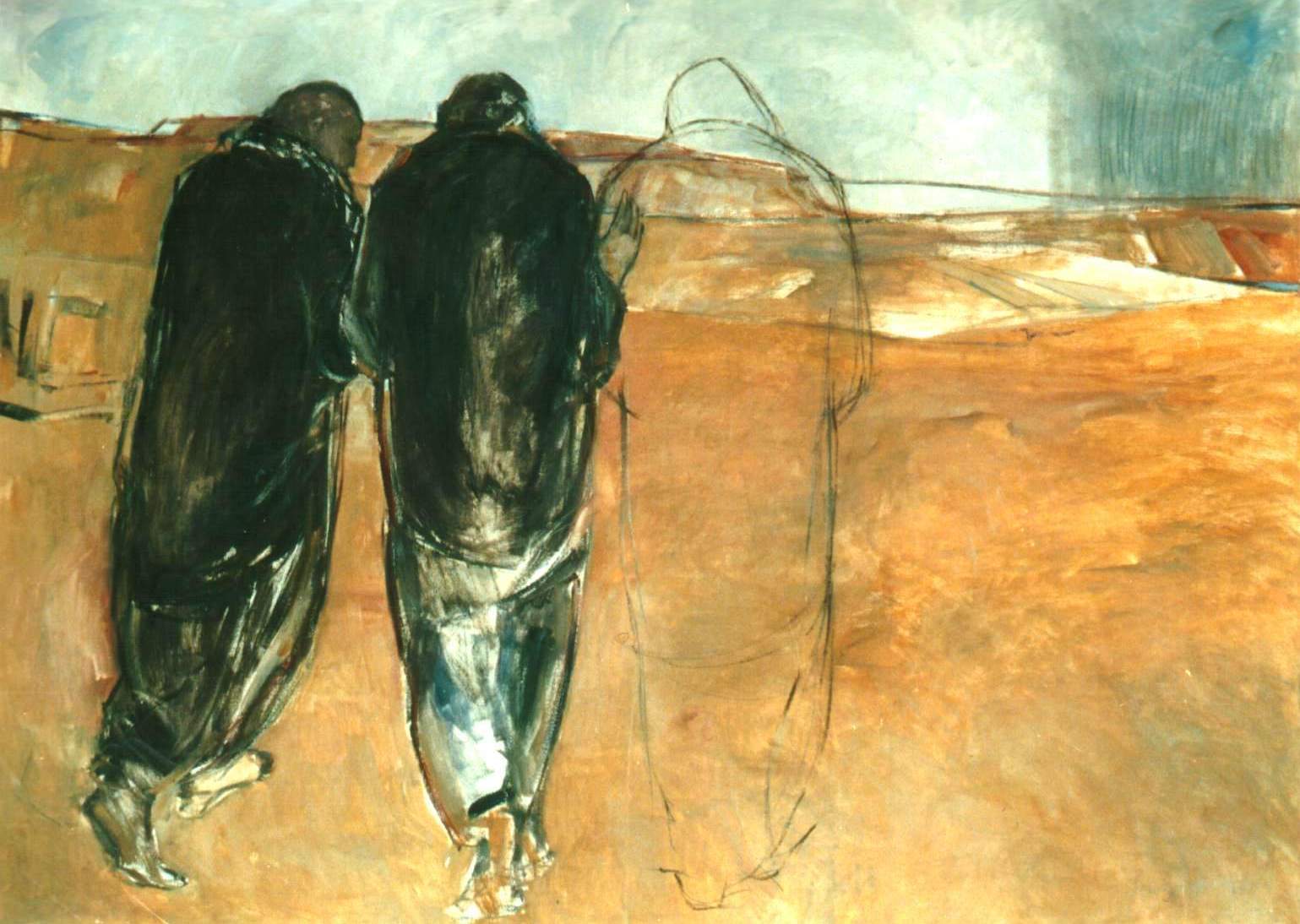
Two disciples are walking along the road to Emmaus, seven miles from Jerusalem, on Easter evening. On Saturday, they had retreated to the upper room, locking the doors for fear of the Jews. They gathered in fear, trying to come to grips with the unspeakable events that had transpired the night before when Jesus had been taken and crucified. Now, in the upper room, they pace back and forth, trying to make conversation, engaging in uncomfortable small talk, trying to deal with their loss and the horror of the events surrounding it all.

Then Sunday comes: the sun comes up, the city goes about its business as usual, like any Monday morning here in Roxbury. Life goes on, as if nothing has happened. There’s always something about that realization that stuns you when someone you love dies, someone that you’ve never imagined living without. Your life is shattered. Then, after the funeral, you walk out to your car, and the sun is shining, the traffic is moving, and someone is cutting their grass. Life is moving on. You wonder how that can happen. It seems like no one understands that something important has happened. Your life has just fallen apart. But it seems to barely register a blip in the pulse of the world.

Sure, a couple of women had returned from the tomb that morning in hysterics, but the disciples knew the women’s loss was at least as great as theirs, so they understood. The facts of life are sometimes hard to deal with, and each of us has to work out our grief in our own way. The women got hysterical, Thomas shipped out, and these two disciples took a walk. They just had to get away for a while. They needed to escape the situation, to get out of town, away from Jerusalem for a while.

Emmaus was, and is, a lovely place. There’s a beautiful garden there with rosemary hedges and almond trees that are in full bloom this time of the year. The garden is still there, part of a monastery that now sits on the site. It’s no wonder the disciples wanted to take a break to go to Emmaus. Emmaus is that place where we go to find the joy and meaning we aren’t finding in life. It’s a secluded, beautiful spot where we can take our broken life, lick our wounds, and hopefully, gather enough strength to come back and go on.

But along the way, they are joined by a third party, a stranger. They’re deep in thought, deep in discussion, so they really don’t pay too much attention to what he looks like. It is Jesus who has come to meet them, out on the road, not waiting for them to come to him. As they’re walking away from the situation, trying to cope, trying to get things straightened out in their hearts and heads, before they’re able to get a handle on what has transpired, in the midst of their grief and confusion, Jesus comes to them.

“What are you discussing?” he asks. And one replies, “Are you the only one who does not know of the things that have taken place these past few days about Jesus of Nazareth?” And we too reply, “Are you the only one who does not know the things that have taken place? 
  • Have you not heard that someone I love so much has just died?
  • Have you not heard that I was diagnosed with cancer?
  • Have you not heard that I lost my job?
  • Have you not heard that my parents are splitting up?
  • Have you not heard that I’m dealing with an addiction that I just can’t seem to break? 
  • Have you not heard that I think I’m gay and I’m scared that my family and friends won’t accept me?
  • Have you not heard that I’m so depressed that sometimes I don’t know how I’m going to get out of bed in the morning, and sometimes feel like ending it all?”
  • Have you not heard that my problems and the pressures of life are so overwhelming me, I just can’t see the light at the end of the tunnel?

But he has heard and he is there. He is there, but he is not recognized. He is there but he is hidden. He is there, but we do not see him. We think he has deserted us when, in fact, he is walking with us, bearing us up, opening his promises to us. He is allowing us to see how he fulfills his promises if we will listen, and still we do not recognize him. Our eyes are still blind. The world seems more real to us than its creator. Our fantasies seem more appealing to us than his presence.

As they go along the road, Jesus talks to them about God’s promises and their fulfillment in the Christ. His words give them consolation in the midst of their grief and hope, in the midst of their doubt and confusion. So when they arrive at their destination, they prevail upon this one whom they only see as a stranger to sit and dine with them. Away from Jerusalem, in this safe house, they can let their guard down a bit. A little of the tenseness has left; they breathe a sigh of relief. Now they can relax, get their minds on to other things before they go on, before they have to face up to a future without the one on whom they put pinned their hopes, the one they had loved. 

They sit down, share a glass or two of wine. A few pleasantries are passed. Then Jesus takes the bread from the table, blesses it, breaks it, gives it to them. And suddenly they are no longer in Emmaus. They’re sitting around the campfire on the road by the Sea of Galilee. They’re sitting on Mt. Tabor, surrounded by a huge crowd, and Jesus is blessing and breaking loaves and fishes, while talking to them about the Kingdom of God. They’re sitting at the Last Supper in the upper room in Jerusalem, and Jesus is telling them of his death and resurrection. Suddenly it all comes together in one moment - all of their experiences, all he had said, and they recognize who it is that is in their presence. It all comes together. And they say to one another, "Didn’t our hearts burn within us as he talked?” When they finally realize who it is that has broken the bread, they also realize that it was he who has been with them all along.

Although two disciples walked the road to Emmaus that Easter evening, only one of them is named – Cleopas. Maybe that’s because the other one need not be identified. We’re all too familiar with who it is. It’s us. It is you and it is me. Where are you along that road? Are you disillusioned with life? Are you fed up, tired, burnt out? Are you looking for relief, longing an Emmaus? Are you thinking that life is somewhere out there, yet to be discovered? Do you feel like maybe you’ve missed something? Which way are you traveling this morning?

Wherever you’re going, by whatever road, I want you to know this morning that Jesus is there with you. He is alive, and he is available, and he is trying to open the door of your heart, as well as the eyes of your mind, to receive him. He comes to us, the slow of heart, and walks with us, and talks with us. He takes the time to open to us the wonderful promises of God, if we will take the time to walk with him, to stay with him for a while, to feed upon him. He comes to you today, in the hearing of his word in Sacred Scripture and in the breaking of bread, in his sacramental presence, and in the stranger, the one in your midst, the one who might be sitting on your right or on your left, the one who sits across from you at your kitchen table. 

He comes to you today, to this, his broken body, to give us the gift of his presence, so that we may also minister healing, minister peace, to a broken and tired world. He comes to give us hope, to share with us his peace, the peace that only he can give. He comes to restore life to us, as he did to those disciples, who went away saying, “Didn’t our hearts burn within us as he spoke?" They went away with new life. And so can we.

Sunday, April 2, 2017

The Fifth Sunday of Lent (Cycle A)

OPEN THE TOMB
Ezekiel 37: 12-14; Romans 8: 8-11; John 11: 3-7, 17, 20-27, 33B-45 

His question was simple enough: “I am the resurrection and the life, the one who raises the dead and gives life. Those who put their trust in me will have life, even if they die. Those who live trusting in me, will never succumb to death. Do you believe this?” 

Your answer was simple enough too: “Yes, Lord. I believe that you are the Messiah, the Son of God; the one whose arrival the world has been waiting for.” But answering questions is the easy part. Even when the answer is extraordinary, almost unimaginable. Even when the answer means that the ordinary looking person in front of you is no one less than the God of the universe, the life-giver, the one who creates something out of nothing, life out of death. 

“Do you believe this?” “Yes, Lord, I believe.” Just a few simple words, really. Nothing to it. 


“Roll back the stone. Open the tomb.”


What?! Open the tomb? Don’t be ridiculous. What’s in there is long dead.


Open the tomb.


Come on it is hard enough to view the dead before burial let alone digging up what is half decomposed Don’t make me do this.


I am the resurrection and the life.
Do you believe this?

Yes, Lord. I believe. 

Open the tomb.


It’s going to stink to high heaven in there. We’ll all be sick. That stone is in place for a good reason. It is not healthy to expose yourself to what’s in there. Just leave it be.


I am the resurrection and the life.
Do you believe this?

Yes, Lord. I believe.

Open the tomb.


Can we talk about this? Okay, I’ll admit it, it’s not just the stench I’m afraid of. There’s more to it than that. It’s what it would mean for me. Sometimes when things are laid to rest, you’ve just got to let go and move on. It’s not healthy to keep raking over the ashes. Sometimes you have to shut yourself off, sever the emotional ties and stop dwelling on the past to protect yourself against the pain. You’ve got to let go of the “if only”s and accept that those hopes and dreams are gone. That the chapter is closed. That you have to get on with life as it now is, poorer perhaps, but with both feet firmly on the ground. I’ve done my best to move on. I’m coping okay. Don’t ask me to go back. 


I am the resurrection and the life.
Do you believe this?

Yes, Lord. I believe.

Open the tomb.


Can’t we just leave it. Can’t we just walk away. Can’t we let the dead rest in peace. Maybe some of what’s dead in there died because I gave up too easily. Maybe it didn’t need to die. Maybe if I’d looked harder or fought longer it wouldn’t have died. Maybe if you’d been here with me it wouldn’t have died. You could have done something. You could have given me the courage and kept me from giving up. If only you’d been here it wouldn’t have died. But it doesn’t matter now. It makes no difference now why it died. It’s dead. Gone. Extinguished. No more for this world. Whether its death was unavoidable or not, it died. Why look on the horror of it all now? Why dredge up the misery, the shattered dreams, the agony of lost hopes? Why?


I am the resurrection and the life.
Do you believe this?

Yes, Lord. I know all that.

Open the tomb.


I can’t. You don’t understand. You don’t realize what it would cost me to go back there. Do you know what it’s like when something within you dies? When you abandon hope? When you give up trying to make something work and just let it go? Some dream. Some hope that kept you going for years, maybe even a lifetime? Some relationship. Some passion. Some ability that others don’t appreciate or maybe even recognize. Some flame of faith. Something that is unique to you. Something that makes you who you are or could make you who you could have been. Do you know what it is like to give up? To watch it slip away? To steel yourself against the pain? To bite your lip and fight the tears? To not let it show? To pretend you’re better off without it because that’s what everyone else thought anyway? Do you know what it costs to close that tomb and to return to life as though nothing had happened? But some things have to die. They don’t fit in the real world. They don’t belong. They cause more pain than they’re worth. They make life difficult. They have to be given up so you can fit in, and go with the flow, and be accepted by those around you.


I am the resurrection and the life.
Do you believe this?

Yes, Lord. I believe it. I’ve got it all down pat.

Open the tomb.


Do you have any idea what you’re asking me? To open it up again? To make myself vulnerable again? What if it just opens up all the old wounds and everything is just as complicated as before? Just as painful? Just as unbearable? What if it undoes all the good progress I’ve made? What if I believe again, trust again, open myself up again, and just get destroyed again? What if I just get my heart torn out and trampled over again? I couldn’t face that. Just let it rest in peace. It can’t do any harm behind that stone. It’s safe. I’m safe! Don’t go stirring it up again. Just let it rest in peace. I can’t take the risk. If you put flesh back on those bones and breathe life into that body, there will be nowhere for me to hide. All that unfinished business will be back on the table. Everything will be raw and vulnerable and terrifyingly alive.


Open the tomb. 
For I am the God of Abraham, the God of Isaac, and the God of Jacob. I am not the God of the dead but of the living.1 I wound, but I bind up; I shatter, but my hands make whole.2 I will open your graves and have you rise from them. I will put my spirit in you that you may live.3 I will wipe away every tear from your eyes; and there will no longer be any death; there will no longer be any mourning, or crying, or pain, for the former things have passed away.4 By my stripes, you are healed. 5Trust in me with all your heart and lean not on your own understanding.6 For behold, I create new heavens and a new earth, and the former things shall not be remembered or come into mind.7 I will open rivers on the bare heights and springs in the midst of the valleys; I will make the wilderness a pool of water and the dry land fountains of water.8 Thus you shall know that I am the LORD. I have promised it, and I will do it See! I make all things new!9


I am the resurrection and the life.
Do you believe this?
Open the tomb.


Passim:
1. Matthew 22:32
2. Job 5: 18
3. Ezekiel 37: 12-13
4. Revelation 21: 4
5. Isaiah 53: 5
6. Proverbs 3: 5
7. Isaiah 65: 17
8. Isaiah 41: 18
9. Ezekiel 37: 13-14

Sunday, February 26, 2017

Eighth Sunday in Ordinary Time (Cycle A)

WE DO NOT WALK ALONE 
Isaiah 49: 14-15; 1 Corinthians 4: 1-5; Matthew 6: 24-34

A few years ago, a friend gave me a wonderful book: “Why Faith Matters” by Rabbi David J. Wolpe, a popular author and commentator based in Los Angeles. In his book, he talks a lot about the lessons he’s learned from facing various crises in life. One story he draws upon in the book tells of the impact the death of his grandfather had on his father, then a boy only eleven years old. The boy, an only child, ended up bearing much of his grief alone. 

Following Jewish tradition, he walked to synagogue early every morning to say prayers in his father’s memory – a practice he undertook for a full year. Early on, the little boy spotted the synagogue’s elderly ritual director, Mr. Einstein, walking past his home just as he left to go to the synagogue. The old man said to the boy, “Your home is on the way to the synagogue. I thought it might be fun to have some company. That way,” the old man said, “I won’t have to walk alone.” So for the next year, the little boy and the old man walked to the synagogue together, through all kinds of weather, all the different seasons. They talked about life and loss, sorrow and fear. And gradually, with the old man at his side, the little boy felt less and less alone.

Well, the boy grew up and married and later had a family of his own, and he decided to contact Mr. Einstein – by then into his 90s – and ask if he’d like to meet his family. Mr. Einstein was delighted, but said, since it was hard to get around, they’d have to come see him. Rabbi Wolpe then quotes from something his father later wrote about that trip: “The journey was long and complicated,” he wrote. “His home, by car, was fully 20 minutes away. I drove in tears as I realized what he had done. He had walked for an hour to my home so that I would not have to be alone each morning.”

The story of that little boy and the old man is really our story, yours and mine. It is the story of every one of us making this unpredictable journey through life – a journey that is often not easy. But no matter what we may think: we are not alone. God goes out of His way to walk with us.

We’ve been up on the mountain with Jesus for five weeks now listening to his Sermon on the Mount, one of five great sermons, or discourses, that we’re presented with in Matthew’s Gospel. In this first one, Jesus addresses His moral teaching. He’s told us that the way to true happiness is to be poor in spirit, gentle and merciful, to mourn, to care for what is right, to be pure in heart, to make peace, and to be persecuted for what is right and holy. He’s encouraged us to let the light of our goodness be a beacon for the world. And He’s instructed us that living the Law means more than just living by its letter. It means embracing its spirit. Today, before He leads us down off the mountain, He reassures us just how special we are in the eyes of God. He tells us that if God takes care of the birds of the sky and the fish of the sea and the lilies of the field, how much more will He look after us. 

At least four times in today’s Gospel, Jesus cautions us not to worry or be anxious. Easier said than done. When deadlines loom or money seems short or things I’ve done or words I’ve said I wish I could take back, I worry. Will I have enough time to finish this project? Will I have enough money to pay my bills? Will the person I’ve hurt forgive me? Will God forgive me? Conditions in our world cause concern. When will we have peace all over the world? Can we heal the divisions in our nation? Can the tide of terrorism be stopped? How do we stop violence and welcome the stranger and those we name strange because they differ from us? . . . Not worry? How can we NOT worry? 

Our first reading today from Isaiah assures us that, no matter what, God will not forget us, as a mother cannot forget the child of her womb. And in the gospel, Jesus goes even further. Don’t worry, He says, about what you have today or where you have to go tomorrow, or how you’ll get there. Because we are not walking alone. Like that old man with the young boy, God walks with us. In our uncertainty, in our anxiety, in our grief, in our joy, whether we understand it or not, whether we sense it or not . . . God is beside us. And it’s even better than that - He doesn’t just walk beside us, He walks ahead of us. God isn’t bound by time and space. He exists in the eternal NOW, so God is already in the future that today we fret about and try to have control over. 

But we often forget that, don’t we? We have this need to always feel as if we’re in control of everything. Guess what: we aren’t. So, Jesus reminds us: Take one day at a time, one step at a time, one moment at a time. God knows our needs and will care for us. As St. John Paul II once said, “Remember that you are never alone, Christ is with you on your journey every day of your lives” . . . “Have no fear of moving into the unknown. Simply step out fearlessly knowing that (he is) with you, therefore no harm can befall you; all is very, very well” . . . “Do this in complete faith and confidence. Walk with him who is ‘the Way, the Truth and the Life’!” 

It comes down to this: We need to let God be God. Let God be who he is: our Creator, our Father, our Inspiration, our Guide. Let Him do His divine work. Let God challenge us. Let God ask us to be stronger than we realized we could be. Let God take us where we may not want to go. Let God make us what we were meant to be. He knows what WE’RE capable of. We need to remember what HE is capable of? The God who feeds the birds and clothes the flowers parted the Red Sea, gave sight to the blind and raised His only Son from the dead. He’s the God who knows every need, hears every prayer, sees every tear and bestows every blessing. 

So, let God be God. Let Him work miracles in our lives. And we can only do that by letting Him INTO our lives. We need to let Him in. Let Him love us. Let Him comfort us. Let Him help us carry our burdens.

The psalm we sang this morning cries out: “Rest in God alone, my soul.” Or as St. Augustine once prayed: “Our hearts are restless until they rest in you.” Our restless hearts will only find their rest by trusting in God’s love and mercy, by turning to Him in our need and in our fear, and having faith . . . faith that our future really is in His hands. 

This week, let’s pray for that sense of trust, the same trust that will lead us to say in just a few moments: “Thy will be done.” Embracing that can save us all a lot of sleepless nights – freeing us to face every tomorrow without fear, and so continue our journey. The journey is long. And it isn’t easy. But take heart, and have hope: we do not walk alone.

Sunday, January 29, 2017

The Fourth Sunday in Ordinary Time (Cycle A)

BLESSED and HAPPY
Zephaniah 2:3, 3: 23-13; 1 Corinthians 1: 26-31; Matthew 5: 1-12a 
I think it’s a safe assumption on my part that we all love Jesus. We wouldn’t be here this morning if we didn’t. But as I was reflecting on today’s Gospel this past week, an unsettling question came to mind: If we lived in first-century Israel, would we like him? Let me explain the reason for this question. Most of us tend to prefer people who are predictable. We like the person we know we can count on for a well-timed joke. We like the person who will show up when they commit to something. We tend to prefer people we can read; either they tell us outright what they’re thinking or their facial expressions do. We like it when people say what they mean and mean what they say. We tend to prefer people who are logical and draw understandable conclusions. Basically, we like people we can easily peg.

Jesus was not one of those people. He wasn’t predictable. He wasn’t easy to read. He wasn’t always logical, at least not by the norms of his culture. He was enigmatic. Everything about him was a puzzle. His birth to a virgin, his hometown, and most certainly his teachings were all confounding and defied conventional wisdom.

Matthew’s anthology of Jesus’ teachings, collectively known as the Sermon on the Mount, begins with the Beatitudes, a litany pronouncing blessings upon what are apparently the lowliest of people. Jesus climbs a mountain and below him, in the crowd, where the world sees weakness, he sees strength. Where the world sees poverty, he sees wealth. Where the world sees deprivation, he sees power. Here Jesus shows himself to be not only enigmatic but also counter-cultural. He was then. And he is now. Although Jesus presents the Beatitudes as blessings, we often perceive what he proposes as curses. Let’s listen to him again about happiness, about the way to heaven, about the way to holiness:
  • Whereas the world says you have to be rich to be happy, Jesus says “Blessed are the poor in spirit, for they will inherit the kingdom of heaven.”
  • Whereas the world says, you’re happy when you don’t have a concern in the world, Jesus says “Blessed are those” who are so concerned with others that “they mourn” over the others’ miseries, “for they will be comforted” by him eternally.
  • Whereas the world says, “You have to be strong and powerful to be happy,” Jesus says “Blessed are the meek, for they will inherit the earth.”
  • Whereas the world says, “To be happy, you’ve got to be a sex god,’” that “Happy are those who indulge themselves with pleasure.” Jesus says “Happy are the pure of heart for they shall see God.”
  • Whereas the world says, “You’re happy when you accept yourself as you are,” Jesus says, “Blessed are those who hunger and thirst for holiness and grace, for they will be filled.”
  • Whereas the world says, “You’re happy when you don’t start a fight, but you finish it.” Jesus says “Blessed are the merciful, for they will receive mercy” and “Blessed are the peacemakers, for they will be called children of God.”
  • Whereas the world says, “You’re happy when you don’t make waves, you go with the flow, and everyone embraces you as nice,” Jesus says, “Blessed are those who are persecuted for righteousness’ sake” and “blessed are you when people revile you, persecute you and utter all kinds of evil against you falsely on my account,” “for your reward will be great in heaven.”
So what was the message to the disciples, and what is the message for all of us here today? Jesus is telling us that the very values that we hold so dear, prosperity, security, happiness, and everything we strive so hard to achieve for ourselves and our children are practically worthless when it comes to considering the values of the Kingdom of God. Jesus lays it on the line. He says to us, “It comes down to this: Do we trust the world to bring you happiness or do you trust God? And if it’s the world, how’s that going for you?”

Jesus proposes a different way to happiness – the way of the Beatitudes. It’s a way where we replace greed with simplicity, indifference with compassion, self-promotion with humility, ego and satisfaction with the status quo with a craving for holiness, the need always to be right with tolerance, the lust for pleasure with purity, the quest for power with justice, and our craving for acceptance and affirmation at all cost with fortitude. 

Why does Jesus say that the poor in spirit, those that mourn, the meek, those that hunger and thirst for righteousness, the forgiving, the peacemakers and the persecuted are happy and blessed? Because they have allowed God to be close. There are no obstacles between them and God. On him, they are totally dependent. His words are their joy. His values are their treasure. His promises are their hope. His example is their guide. 

We’re told that St. Francis of Assisi got completely undressed in the middle of his town square. He gave all his possessions back to his father and then he was ready to begin. We need to do the same. We need to be naked, to strip ourselves of all that comes between us and our God. For it is only when we rid ourselves of that which is an illusion and is fleeting that we can possess that which is real and eternal. 

In the end, Jesus doesn’t merely speak the Beatitudes. He lives the Beatitudes. He is the Beatitudes. Looking at him you will see what it means to be poor in spirit, gentle and merciful, to mourn, to care for what is right, to be pure in heart, to make peace, to be persecuted. This is why he has the right to say, “Come, follow me!” He doesn’t say, “Do what I say”. He says, “Come, follow me!”

We’re called, too, not just to hear the Beatitudes, not just to live the Beatitudes, but to be the Beatitudes. The Beatitudes describe both the face of Christ and the face of a Christian, the face of one striving, with God’s help, to become a saint. St. John Paul II called it the Magna Carta of Christianity and said that the way of the Beatitudes is the way to happiness, holiness and heaven. 

Let’s pray for that. Through this Eucharist, may Christ Jesus our Lord help us to have that hunger, have that thirst, have that desire for holiness, for living the Beatitudes, so that one day we will indeed be satisfied FOREVER. 

Hmmm. Maybe had I lived in first-century Israel, I would have liked Jesus after all.

Sunday, January 1, 2017

The Solemnity of the Blessed Virgin Mary, the Mother of God

PONDERED IN HER HEART
Numbers 6: 22-27; Galatians 4: 4-7; Luke 2: 16-21 

Did you ever see the movie, “The Natural?” It’s one of my favorites. The 1984 film stars Robert Redford as Roy Hobbs, a baseball prodigy, a “natural,” whose career is sidetracked when he’s shot by a woman whose motivation remains mysterious. Most of the story concerns itself with his attempts to, not only return to baseball later in life, but to become the best player the game has ever known when he plays for the fictional New York Knights with his legendary bat, “Wonderboy.” When I saw it when it was first released (at what used to be called Cinema 10), I remember remaining in my seat as they ran the credits, thinking to myself: “What a great movie! It had everything you could want from a sports story: greed, sex, betrayal, and a whole lotta baseball. But what the heck did it mean?” I realized there was a deeper meaning to the story that I just wasn’t getting, and I sat there long after the other movie-goers left the theater trying to figure it out. But for a long time, its meaning remained a mystery to me. When it was released on home video, I bought a copy and watched it several more times, still groping to figure out what the movie was really trying to say. Finally I got it! And I decided it was a perfect movie to show to my junior morality class at Bergen Catholic. After I did, I explained to them that Roy Hobbs was a symbol of Everyman and that the movie was a metaphor for man’s struggle with good and evil. I pointed out how the director used light and dark to help get this across, that the movie’s title didn’t just speak about Roy’s natural abilities, but the natural state of man, and that the dramatic conclusion of the movie was meant to convey the ultimate triumph of grace against sin, good vs evil. When I finished, I asked my class for their reaction. They stared back at me in silence. Were they as moved as I at the movie? Had I just given the lesson of my life and they sat there speechless in rapt awe? Finally, one of my students raised his hand. He was the smartest student in the class and I was anxious to hear what his insight might be. I said, “So what do you think, Chris?” Chris responded, “Deac . . . It’s a movie about baseball!” I looked around to the other members of the class, and they nodded their head in affirmation. – It was just a movie about baseball. Well, thank goodness, the bell rang signaling the end of class or my students would have seen a grown man cry. They didn’t get it. They didn’t see what I saw. This was far more than just a movie about baseball.

My struggle to find the meaning behind the movie “The Natural” is what Mary did with all the experiences of her life. In today’s Gospel, we hear that Mary reflected in her heart the story of all the shepherds had seen and heard. The thing is, she did more than that. Sometimes our English translation of Scripture does a poor job at getting across the precise meaning of the original Greek. And today’s passage is one such example. More on the mark than reflected, the meaning of the original Greek text is better translated pondered. To ponder is “to consider, to weigh, to hold in balance.” It means to think about something carefully in your head - to weigh it in your mind. It implies a serious process of mental activity – a careful consideration of all the factors involved. But for Mary, it doesn’t stop there. She ponders it in her heart. And so, there’s an important emotional and spiritual overlay to this process. To ponder in our heart is to try to feel it out as well as to think it out: to discern what its meaning is, and to allow it to change our life. I don't think that Mary pondered the great mysteries of faith.  I think she pondered in her heart the events of her life and tried to discover the presence of God in them,  We need to do the same.

We get the sense in Luke’s Gospel that this sort of internalization was the pattern of Mary’s life. Three times within the first two chapters of Luke’s Gospel we’re told that Mary does this. In addition to what we heard this morning, we’re told that she pondered the angel Gabriel’s words to her, “Hail Mary, full of grace! The Lord is with you” and what such a greeting might mean. We’re also told that twelve years later, after searching for Jesus for three days and finding him in the Temple sitting amidst the teachers, listing to them and asking them questions, Mary and Joseph returned home to Nazareth where she “treasured all these things in her heart.” Luke should know. Catholic tradition tells us that after he was converted by St. Paul, he traveled to Israel to “investigate everything accurately anew,” and that this quest brought him to Mary herself and that he based the Infancy Narrative of his Gospel on that interview. And I’m sure it’s not a stretch of the imagination that there were thirty-three years worth of words and memories that Mary took to heart, pondered, discerned, and sought to discovered the hand of God in, even the death of her Son on the cross. 

I’m wondering this weekend, this New Year’s weekend, what memories of 2016 are you and I are keeping, storing, holding in our hearts? Was 2016 a good year or a hard year? a happy year or a sad year? A healthy year or a year of sickness? Was it a year of gain or a year of loss? A year of pain or a year of peace? Did the year seem to fly by or did it creep at a snail’s pace?

My physical heart has only four chambers but my soul’s heart has many more than four. With what memories has last year filled the chambers of my heart? Am I keeping some hurtful memories alongside some happier ones? Am I holding on to some resentments and grudges or have I filled some chambers with forgiveness, with peace-finally-made?

Is there a chamber in my heart now empty because I’ve lost someone or a relationship ended? Have I locked up that empty place - or left it open, waiting for it to be filled with consolation and healing, with fresh affection?

In the past year did my heart expand to accommodate everything that came my way, peace and pain alike? Did my heart enlarge to welcome God’s grace in my joys and his gentle touch upon my grief?

In 2016 did I turn to the Jesus living in my heart: to lean on his strength in my weakness, to depend on his counsel in my doubt, to seek his wisdom in my confusion, to reach for his companionship in my loneliness?

Mary would come, eventually, to keep in her heart not only joyful recollections of Jesus’ birth but also the painful memories of his suffering and death. And so it is with us, too. Our hearts are the storehouses of all that has shaped us to be the persons we have become, and our hearts are the Lord’s dwelling place where he wants to forgive our sins, heal our wounds, calm our fears and give us the peace that comes only from his heart, from his hand.

And so, on this Solemnity of Mary, the Mother of God, as we’re presented with the example our Blessed Mother, let’s not make this New Year’s Weekend just an experience of Auld Lang Syne. Let’s not just reflect on the events of the past year, Let’s PONDER them . . . ponder them in our heart.  Let’s connect the dots, see their deeper meanings, and realize the presence of God in it all. For sure, the year ahead will find its own share of blessings and sorrows filling our hearts. But let’s pray that we come to the end of 2017 through His grace, in His peace, and held in His strong arms. Happy New Year.

Sunday, November 27, 2016

The First Sunday of Advent (Cycle A)

CHILD OF HOPE
Isaiah 2:1-5; Romans 13: 11-14; Matthew 24: 37-44 

The vestments are violet, the wreath has been blessed and the first candle lit. We’ve sung “O Come, O Come, Emmanuel,” and we’ve just heard familiar themes in our Scripture readings. Time has changed, a new liturgical year has begun, and, once again, we celebrate the season of Advent. We're beginning to prepare for Christmas. And outside the walls of this church, the world has been splashed in red and green, silver and gold. Santa has left the North Pole and came to town as the finale of the Macy’s Thanksgiving Day Parade. Holiday music and movies stream non-stop, and shoppers and stoves work overtime preparing delights for both the young and the young at heart. Yes, time has changed, a new season is upon us. We’re beginning to prepare for Christmas. 

There’s something about this time of year that puts us in a different frame of mind, a different kind of disposition. After the leaves have all fallen and the world has become more desolate and cold; after life has taken on a dreary cast and we, too, feel somewhat dreary after struggling through another year - suddenly there’s this season that's full of hope for a new beginning, for new life - a promise that life can be different, that there are new possibilities for life and for living. Not like the renewal of spring, when that which seems dead suddenly springs back to life - but a whole new world that comes into being, a magical world full of flying reindeer, elves, snowmen and Santa Claus. A world full of new possibilities, a place of great magic, a place where it seems anything could happen. We hear it in the carols, the poems, traditions and stories that surround the season.

And we see the babe of Bethlehem in that same light too - as the One who is our hope for this world and the next . . . the one who offers us new life, not in a place of magic and fantasy, but in the reality of his kingdom. Isn't that the stuff of which Christmas is really made? And Advent, this season we celebrate now, is its sign-post, pointing the way to Christmas, and to hope, to this new kingdom, this new world of possibility, this peaceable kingdom. This is a time of preparation and anticipation. Shopping, candy ribbons and Advent calendars, the special services and the lighting of the Advent wreath - all help us to prepare, all point us toward the hope of the Christmas child.

The readings today alert us to something great about to begin. The language is emphatic. Night is ending. Dawn is at hand. “Stay awake.” Put on “the armor of light.” And “let us go rejoicing to the house of the Lord.” There’s a sense of anticipation – the kind we celebrate at every Eucharist, when we pray that we “wait in joyful hope for the coming of our savior, Jesus Christ.” Advent is that waiting, that moment of joyful hope, lived out across four weeks.

We symbolize that, and ritualize it, with the Advent wreath. We sing it in the haunting refrain, “O come, O come, Emanuel, and ransom captive Israel…” We are captives awaiting freedom, prisoners held in dungeons of despair. But light is coming. Freedom is coming. Jesus is coming. But until he comes, we wait, and watch, and wonder, and pray.

We shouldn’t rush it. Advent is the time for taking stock, and making plans – a season of great expectations. We are like parents today, who are expecting a new baby. We keep a light touch on this season's belly, feeling every movement of the hope about to be born to us. All the preparations are like the preparations of a parent awaiting their new child - the decorating, the parties, the checking off of the days on the calendar - so that we can feel the infant as it kicks and squirms, anticipating the day of its arrival among us.

God has sent us a Child of Hope. He has sent him to be our "Emmanuel," "God with us." It’s a wonderful and miraculous thing God has done. We need to be sure the incidentals don't crowd him out. The shopping, the baking, the carols and decorating - all of those things can be great ways of celebrating the miracle - but they are just the window-dressing on the season. If they become the focus, we will get to the end of the season, and wonder what happened - what happened to our hope? What happened to our Christmas child?

Jesus is coming soon. Our child of hope. The signs of his coming are already all around us. Not in the tinsel and glitter and merrymaking. Not in the lovely carols or beautifully-decorated houses. Not in any of these things at all. But in the very things that, Jesus says, seem to deny his coming and the hope of the season.

It will be as in the days of Noah, Jesus says. When things are "business as usual." Where some are partying and having a good time in the midst of those who are poor, hungry, desperate. When you see that happen, then you know the kingdom is near. When you see cruelty, disruption, discord, hatred and strife - then you know that Christmas is just around the corner. When people are hurting, lonely - when life seems out of control, when hope is denied - then you can be sure it is time for Christmas to appear. It's time for the kingdom to come. It's time for the promise to be given birth.

Because it is precisely at these times when the Child of Hope is most needed. In times and in places where hope is longed for, where his healing touch is most needed, where new possibilities need to be opened up for us. It's then that our hearts are open to receive him. It's then that we are ready to entertain new possibilities. It is then that we know that faith is the only way, and God is the only one who can change things. It is then that hope is born, and Christmas comes at last; just as it did two thousand years ago, when the world seemed dark and hopeless.

The promise and hope of Christmas comes when it is most needed. That’s why every moment of life - even when we feel furthest from Jesus - is a moment of hope and possibility - any moment he may come to us, if we are open, like Mary, and Joseph, and the shepherds, to receiving him.

The kingdom is waiting to break into your world this morning. The signs of it are everywhere. Be prepared. Be ready. Not just when the carols are playing. Not just when you feel Christmasy. But also, and especially, when the world seems dark to you and you feel far from your Father's home.

Jesus is coming soon - our Child of Hope. He will come on clouds of angels, to take us home. But he is already present now as well, and his kingdom is near to you. He wants to be born into this tired old world through the entry-way of your heart. Be waiting, be watchful, be ready for his arrival. This is not just another Sunday, another Season, and another day. Are you ready to encounter Jesus? Are you ready for the unexpected to change your life, alter your plans, and disrupt your direction? Let’s look forward to a Merry Christmas. But let’s also use this opportunity, as well, and prepare to receive him this season of Advent. Be still. Be aware. Be ready.

Wednesday, November 23, 2016

Thanksgiving

Lord, how quickly the pages of the calendar have turned and another Thanksgiving Day is upon us. And so, as I pause and reflect, a mind full of memories rush to find expression as a heart full of gratitude wells up within me:

Thank you, Lord, for the splendor of your creation, for the beauty of the world around me . . . for green pastures and still waters and for tall trees that bow their heads prayerfully in the wind. I thank you for the colors with which you paint the seasons and for the passing of those seasons that has brought us to this day . . . for the snow glistened winter and the dogwood spring, for the watermelon summer and the russet and gold autumn.

Thank you, Lord, for this great land, for its bounty and its liberty, for the privilege of democracy and the gift of peace. Thank you for the goodness of our people and for the spirit of justice that fills this nation. I thank you today for the brave people of our land who are more interested in being right than in being popular, and for those who are willing to support a good cause publicly even though they know that cause may not succeed.

I offer you my thanks today for the gift of family . . . for all those who will gather around my Thanksgiving table, and for those who break bread at other tables this year. I thank you too for those who share with you in the heavenly banquet, those whom you have called home and into your embrace. Thank you for relieving their pain and suffering and thank you for all the memories that keep them alive in my mind and in my heart. 

I’m grateful, Lord, for friends who continue to be friends even after they have known me well . . . for those whose nods, winks, and smiles celebrated my joys and triumphs, and whose broad shoulders bore my burdens and lifted me with their compassion. Thank you for all those who have come into my life this year . . . for older people who have shared with me the wisdom of their yesterdays, and for the young whose enthusiasm and zest for life give me hope for tomorrow.

I’m thankful for the talents of others and for those who share them so generously with us, and for advances in technology and medicine that promise us a better day in the future. And I thank you for work which challenges the talents with which I have been blessed, and for weekends and holidays and holy days which refresh my spirit. For days of pomp and pageantry and parade, and for moments of quiet solitude, I thank you.

I give thanks to you today for the wonder of life, the mystery of love, and the gift of faith . . . for the sound of music that fills my soul, for the sound of laughter that lifts my spirit, and for the sound of crying that moves my heart with compassion.

I thank you for cloudy days which help me appreciate the sunshine; for tears which help me appreciate laughter; for pain which helps me appreciate health; for weakness through which I’ve discovered my strength; for sorrow, hurt, and loss through which I have discovered the depth of my own heart; and for failure which has led me to discover my dependence on you. 

I thank you for the Church, for its teaching which informs me, and for its saints that inspire me . . . for the priests, deacons, brothers and sisters who proclaim the gospel, not merely by word but through their tireless dedication to you and your people, and for my fellow parishioners who fold their hands in prayer on Sunday morning and who extend their hands in service and generosity throughout the week. 

But most of all Lord, I thank you for you! I thank you for simply being God and for loving me with a Father’s love . . . for sending your Son to us - for the example of his life and for the redemption that his death and resurrection has won . . . and for the gift of your Spirit, who guides me along the path which I pray someday will lead me home to you. 

For all of this Lord, I offer my thanks to you on this Thanksgiving Day.


Sunday, October 30, 2016

Thirty-first Sunday in Ordinary Time (Cycle C)

AND THE WALLS CAME TUMBLING DOWN
Wisdom 11:22-12:2; 2 Thessalonians 1:11-2:2; Luke 19:1-10 

Joshua fought the battle of Jericho,
Jericho, Jericho,
Joshua fought the battle of Jericho,
And the walls came tumbling down!

Do you remember that song? Many of you, like me, probably learned it as a child attending Sunday School or Vacation Bible Camp. It relates musically in simple fashion the story of Joshua, the one God chose, after the death of Moses, to be the leader of the Israelite people. Under Yahweh’s guidance, Joshua and the Israelites set out to conquer the land of Canaan. But the city of Jericho stood as an obstacle between the people of Israel and them claiming all that God had promised them. Before they could go deeper into the land of Canaan, Jericho had to first fall. The ancient city of Jericho was a great walled city. History tells us that it was surrounded by two massive stone walls. The outer wall was six feet thick and twenty feet high. The inner wall was twelve feet thick and thirty feet high. There was a fifteen foot guarded walkway between these two walls. From a military standpoint, it was virtually impenetrable. A messenger from God appeared to Joshua and gave him special (and very unusual) instructions on how to conquer Jericho. The priests were to carry the Ark of the Covenant with them as they marched around the city walls of Jericho. Soldiers marched in front of the priests and behind them. The priests blew trumpets and marched around the city once each day for six days. On the seventh day they marched around the city seven times. After the seventh time, when the priests blew the trumpets, the people shouted . . . 

And the walls came tumbling down.

About fourteen hundred years later, another man named Joshua (we know him better by the Greek translation of his name: Jesus) entered the city of Jericho and he too made “the walls come tumbling down.” Not walls of stone and mortar that surround a city named Jericho, but walls of injustice and greed that surrounded the heart of a man named Zacchaeus. 

Zacchaeus was a Roman tax collector in the region of Jericho. He had two distinguishing characteristics that are pointed out in Luke’s gospel. He was short . . . and he was rich! Since he was the “chief” tax collector, and since Jericho could have been the richest city in Judea, he was probably very rich. The other thing we also know was that he was hated.

The Romans had devised a clever system for collecting taxes from regions they had conquered and occupied. Instead of the Romans themselves acting as tax collectors, they sold franchises to “businessmen” from the conquered territory. These men then had the freedom to extort as much as they could from their fellow countrymen. As a result, many became rich, and all were viewed as traitors. 

So here comes Jesus through Jericho. And Zacchaeus wants desperately to see him. Maybe he just wanted to catch a glimpse of the one who people said made the blind see, the deaf hear, lepers clean and the lame walk. Or perhaps word had spread that this was a Rabbi who was a friend to “tax collectors and sinners.” Unable to see over the crowd, Zacchaeus climbed a tree to get a look. He could not have imagined that Jesus would stop under the tree, call him by name, and invite himself over for dinner . . . 

And the walls came tumbling down.

We’re not told what Jesus and Zacchaeus talked about over the meal, but we see a changed Zacchaeus. The walls that Zacchaeus had built around his heart, walls of ego, of arrogance, of affluence, of greed, of power, of status came tumbling down, not with the blare of trumpets and the shouts of an army, but simply by the warmth and gentleness of a single voice, “Today, salvation has come to this house, because this man, too, is a son of Abraham.” And amidst the ruins of those walls, Zacchaeus stands up and makes a monumental commitment: “Lord, here and now I give half my possessions to the poor, and if I have cheated anyone, I will repay them four times the amount.” It was the response of a man whose walls were smashed and whose heart was set free. A man whose life had been radically impacted by Jesus. 

Luke doesn’t tell us what happened to Zacchaeus after Jesus left, but second and third century sources say his name was changed to Matthias, and he was picked in the Upper Room to replace Judas. Another early source goes on to say he became the first leader of the church in the Roman capital of Judea, Caesarea by the Sea.

Walls. Walls that surround a city. Walls that surround the human heart. Our Gospel today challenges us to look at ourselves and recognize the walls in our own lives. But here’s the thing about walls: Some walls won’t let you in and some walls won’t let you out. When we build walls around us we deceive ourselves into thinking that we’re protected. But nothing could be further from the truth. When we surround ourselves with walls we not only block out everything outside of us, but we trap everything inside us too. What type of wall do you have? Do you have a wall like Jericho that makes you impregnable? A wall that leaves your heart untouched by the words and example of Jesus? Unpenetrated by the needs of others? Hardened to those who seek your forgiveness? Rigid to those who need your love? Or is your wall like that which surrounded Zacchaeus? A wall that lock you in schedules and time commitments that keep you from prayer and a deeper relationship with God? Is it a wall that holds you prisoner – a prisoner to the mores and attitudes of mainstream society rather than Gospel values? Is it a wall that holds you hostage by the all-consuming need for success, status, wealth and the material comforts of life? Or is it a wall that inhibits you emotionally and renders you incapable of expressing your feelings for fear it will make you vulnerable. There’s only one power strong enough to topple those walls. It’s the same power that created the universe, parted the Red Sea, and made the walls of Jericho come tumbling down. The power of God. 

Today, Jesus says to us as he did to Zacchaeus, “Today I must stay at your house.” Jesus wants to come home with you. He doesn’t want it to be just a once a week Sunday encounter. He wants to stay with you. He wants to be in on every conversation you have, every decision you make, every relationship you have. He desires to knock down any walls that need to be demolished in your life by the power of his love and mercy. But if you notice in today’s Gospel, Jesus didn’t break into Zacchaeus’ house. And he won’t break into yours as well. It’s always God standing at the doorway, seeking but never forcing entry. It’s God always wishing to come in, but never crossing a threshold uninvited. It’s always up to us to welcome God in as he waits patiently for us. So what do you say? Maybe it’s time for us to be like Zacchaeus and climb a tree, go out on a limb, and receive him with joy.

Jesus fought the battle for Zacchaeus’ heart
It was just the start, Zacchaeus’s heart.
Jesus fights the battle for your very heart.
Let the walls come tumbling down.

Sunday, October 2, 2016

The Twenty-seventh Sunday in Ordinary Time (Cycle C)

A LITTLE CHURCH
Habakkuk 1:2-3, 2:2-4; 2 Timothy 1:6-8, 13-14; Luke 17: 5-10 

i am a little church (no great cathedral)
far from the splendour and squalor of hurrying cities
– i do not worry if briefer days grow briefest
i am not sorry when sun and rain make april
my life is the life of the reaper and the sower;
my prayers are prayers of the earth’s own clumsily striving
(finding and losing and laughing and crying)children
whose any sadness or joy is my grief or my gladness
around them surges a miracle of unceasing
birth and glory in death and resurrection:
over my sleeping self float flaming symbols
of hope, and I wake to a perfect patience of mountains
i am a little church (far from the frantic
world with its rapture and anguish)at peace with nature
– i do not worry if longer nights grow longest;
i am not sorry when silence becomes singing
winter by spring, i lift my diminutive spire to
merciful Him Whose only now is forever:
standing erect in the deathless truth of His presence
(welcoming humbly His light and proudly His darkness)

This past week, as I struggled to make sense of mustard seeds and mulberry trees, I thought of that poem by E.E. Cummings. It’s always been a favorite of mine. I’m not sure what exactly E.E. Cummings intended to convey through it, but I know the meaning it has for me. You see, for me, the poem speaks of how I view who I am and the faith I possess. 

I’m not a great Cathedral. I’m no Padre Pio, Mother Teresa or Pope Francis. I’m not a doer of great deeds, a performer of miracles. I don’t bear stigmata. I’ve never moved mountains or uprooted a mulberry tree on command. If Jesus was physically present in our midst this morning, I doubt very much that he would praise me as he did the Canaanite Woman (“Oh great is your faith!”), nor point to me as an example for others, as he did the Roman Centurion (“In no one in Israel have I seen such faith!”). But hopefully, he would say . . . “Bruce, you did that best that you could with what I gave you. Well done, my good and faithful servant!” I am not a great cathedral.

But I am a small church. Perhaps the light of faith doesn’t radiate from me like a magnificent stained glass window, but I hope that some light does shine through the small windows of my soul . . . windows that often could use a good cleaning with Windex. And whereas I haven’t lived out my faith in heroic ways and haven’t demonstrated my faith through miraculous acts, and haven’t experienced dramatic supernatural encounters with God . . . I do remind myself constantly throughout the day that I am in the holy presence of God. I speak to God regularly in prayer and struggle to hear his whispers back to me. I constantly seek to discern his will, to travel the twists and turns of the road along which he leads me. I try to let go and let God and to place my life in his hands. And I strive, as best as I can, to live in his way, the way of truth that has been revealed through his Word and in the teaching of the Church. I am a little church. I am not a great cathedral. And you know what? I don’t have to be. God doesn’t expect me to be. And he doesn’t have that expectation of you either. 

None of us is called to be a Pope Francis or a Mother Theresa. None of us! If we think that’s what God requires of us, we will throw up our hands in despair. You aren’t called to be Pope Francis or Mother Theresa – you are called to be you – to be the unique person God created when he made you. Nothing more. And nothing less. You are called to live in a unique relationship with God, composed of a string of moments of faithfulness – of his faithfulness to you, and yours in response. If you keep holding out for "great faith," you’ll never have it. Great faith is composed only of small moments of faithfulness, just as the greatest diamond is composed only of small atoms of carbon.

Many want "great faith," so that they can be spiritual giants. But that’s not what we need – it’s certainly not what I need. Do you know what I need? I need a faith that gets me up in the morning, believing that God has some promise in store for me today. I need a faith that enables me to believe that when I walk into my office or classroom, that his Spirit, working through this broken-down over-weight deacon, can make a positive difference in someone’s life. I need a faith that enables me to believe that when I minister to someone who is hurting, that God is present with his healing power. I need a faith that enables me to stand at this pulpit on Sunday mornings and say, "thus says the Lord." It's not a faith to brag about, it’s probably not the kind of faith that’s going to get me canonized, but it is what’s required of me.

That’s what you need too. A mother needs enough faith to place her child on the bus for school, trusting that greater hands hold her child for that day. That’s all the faith she needs, and nothing more - nothing worth bragging about, just enough for her to live out her responsibilities as a mom. A child needs enough faith to believe that God holds them in his loving hand – not their whole future, not for eternity (even though he does) – but just for today – that today is his. That’s enough. A person who is hurting or ill needs enough faith to believe that, in both health and illness, God is caring for them, ministering to them, holding them, loving them. That’s all the faith they need – just faith for one moment, one minute, one hour – faith to get through whatever may be happening in their life. That’s all that they need. It’s all any of us need. It’s not the kind of faith that will earn us a chapter in Butler’s Lives of the Saints. But it is enough to do what needs to be done. A life of faith is composed of small acts of faithfulness.

I think the Apostles in today’s Gospel got it wrong. I think they asked for the wrong thing. Rather than, “Increase our faith,” maybe instead their request should have been, “Lord, STRENGTHEN our faith.” And that should be our desire as well. But just the desire for a strengthen faith isn’t enough. Faith is both a gift and a response. The gift comes from God. The response must come from us. And so too must the strengthening. Just as all the good intentions in the world aren’t going to give us a fit body, bolstering our faith doesn’t come from mere passive religious sentiment. It takes work. And the same three principles that we use to develop and maintain a fit body, also apply to a fit faith: We need to take into ourselves that which is nutritious, take precaution from illness, and exercise. And so we need a steady diet of truth and goodness and love and mercy. We need to take into ourselves God’s Word to instruct and inspire us, and the Eucharist to nourish our souls. We need to take precaution from illness – spiritual illness – sin. We need to watch what we say, watch what we do, watch where our minds wander. We need to stay away from the unhealthy people, unhealthy moral lifestyles, and unhealthy places, both physical and virtual, that put us in harm’s way and lead us to the near occasion of sin. And we need to exercise, to practice the faith that we do have in word and in deed because practice does make perfect. 

I am a little church, no great cathedral. And just maybe, so are you. And although our faith may not rise toward heaven like a great steeple for others to take notice of and admire, it is great enough for us to see the invisible, to believe the incredible, and to receive the impossible.